Security Awareness Isn't About Sending Fake Emails. It's About Producing Audit Evidence.
Here's the quiet truth of security awareness: most companies don't wake up craving phishing simulations. They wake up because an auditor, insurer, or customer just asked a terrifyingly simple question—can you prove your people know how to spot phishing?
Then someone Googles "phishing training," buys a campaign platform, and three weeks later the whole company is arguing about email whitelisting while Karen from accounting is still one click away from handing over the VPN password.
Wrong problem. Wrong purchase.
Compliance frameworks almost never prescribe how awareness must be delivered. They require you to demonstrate that awareness exists, is recurring, and can be evidenced. Auditors care about the evidence trail. Methodology is secondary.
This piece is for security managers, IT leads, compliance folks, and ISO project owners who need proof—not another yacht-budget campaign theater.
The Problem Nobody Talks About
The scramble usually starts the same way:
- ISO audit is eight weeks out
- PCI renewal landed in your inbox
- Someone said "SOC 2" in a board meeting and now it's your problem
- Cyber insurance wants a questionnaire answered yesterday
- A customer security questionnaire asks about staff phishing awareness
Panic mode. Budget unlocked. Platform purchased.
But the actual problem was never "we need to send fake emails."
The actual problem is: we need evidence that employees understand phishing.
Those are different jobs. One optimizes for campaign logistics. The other optimizes for measurable competency and exportable records.
What Auditors Actually Ask For
Sit in enough audits and the questions start to rhyme:
- Who completed training?
- When?
- How often?
- What was covered?
- Was understanding measured?
- Can you show improvement over time?
You will almost never hear: "How many fake Microsoft 365 emails did you blast last quarter?"
The evidence chain looks like this:
Training → Assessment → Evidence → Audit
If your stack stops at "we sent emails," you're optimizing for the wrong end of that chain.
Mapping Compliance Requirements
None of these frameworks require a specific vendor or live phishing campaign. They require awareness programs you can demonstrate. Soft language on purpose—we help you support, demonstrate, and evidence. We do not "make you compliant." Auditors decide that. We just make the evidence less miserable to produce.
| Framework | Requirement | How Myra helps |
|---|---|---|
| ISO 27001 | Security awareness | Interactive phishing assessment with completion records |
| PCI DSS | Phishing recognition / staff education | Inbox scenarios with scored results |
| NIS2 | Employee awareness | Continuous exercises and coverage reporting |
| SOC 2 | Security training | Measured completion and reminder trails |
| HIPAA | Workforce awareness | Interactive exercises with exportable proof |
| Cyber Essentials | Phishing awareness | Evidence exports for staff training |
Why Live Phishing Campaigns Are Only One Approach
Live phishing campaigns can be useful. They're also not the only valid way to measure recognition skills—and for a lot of SMBs preparing for certification, they're operationally heavy for the evidence they produce.
Tradeoffs, not a dunk contest:
| Traditional campaign platforms | Assessment-first (Myra) |
|---|---|
| Sends fake emails into real inboxes | Safe inbox simulation |
| Needs email infrastructure / whitelisting | No email plumbing required |
| Can frustrate people ("was that IT again?") | Training-first experience |
| Measures who clicked under surprise conditions | Measures recognition skills deliberately |
| Tests your production mail path | Tests competency |
Surprise campaigns measure reactions under pressure. Structured assessments measure whether people can actually tell phishing from legit—and turn mistakes into learning instead of hallway resentment. Different tools. Different jobs. Pick the one that matches the evidence you need.
Compliance Is About Repeatability
One annual PowerPoint with a sign-in sheet is technically "awareness training." It is also weak evidence.
Stronger evidence looks like:
- Monthly or quarterly cadence (not "that one Tuesday in March")
- Role-aware content where it matters
- Progressive difficulty
- Historical reports you can pull in five minutes
- Trend analysis (are we getting better?)
- Completion tracking that doesn't live in someone's Downloads folder
Auditors love boring, repeatable systems. Be boring on purpose.
What Makes Strong Audit Evidence?
A checklist you can actually use:
- Completion records (who / when)
- Assessment scores (understanding, not just attendance)
- Historical reports (not a single snapshot)
- Improvement over time
- Role-based or team-level views
- Manager-friendly summaries
- Certificates where useful
- Exportable reports (CSV / PDF-friendly trails)
If you can't produce that without three days of spreadsheet archaeology, your "awareness program" is vibes, not evidence.
Features That Matter More Than Fake Emails
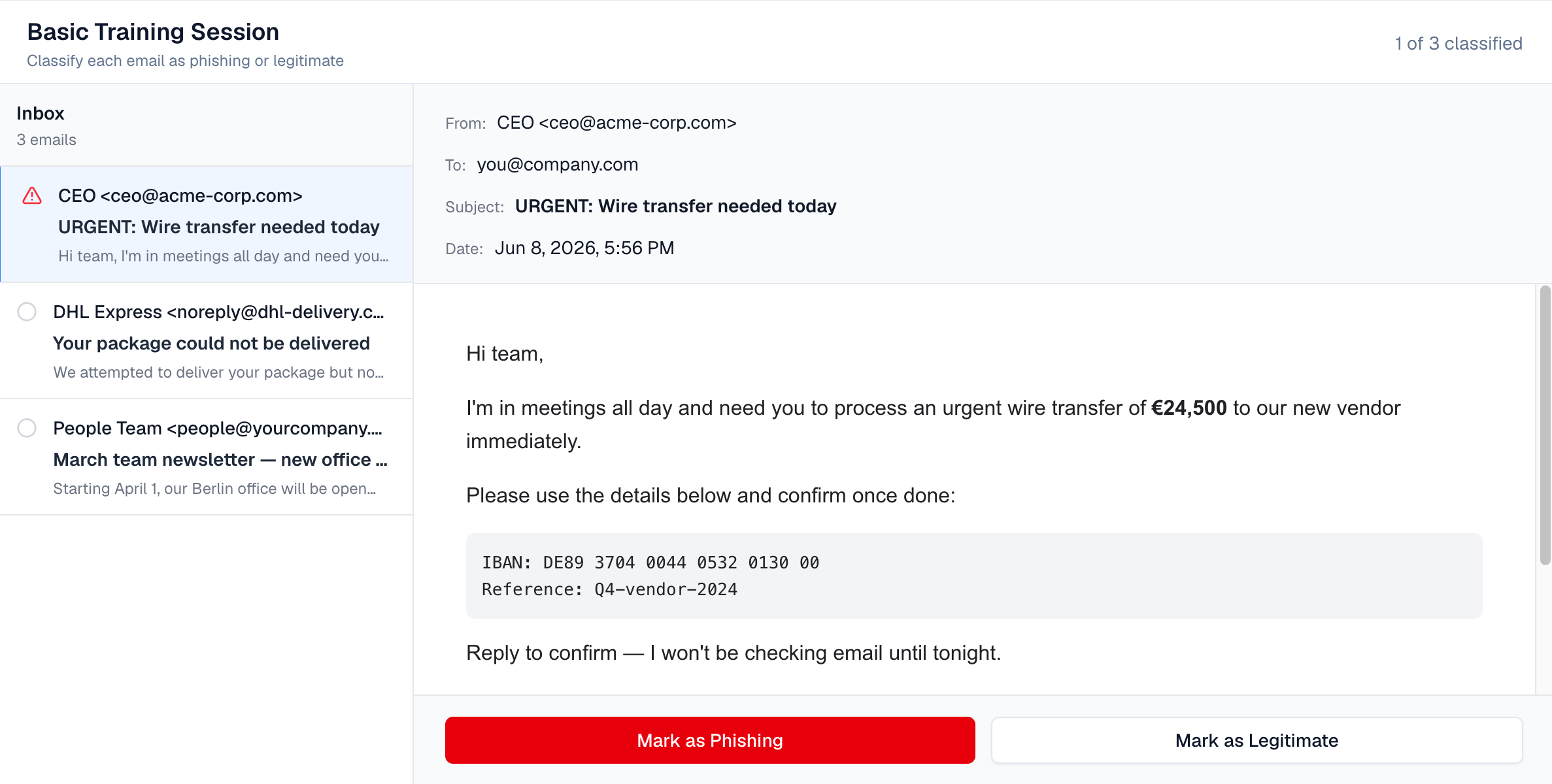
Myra is not another phishing campaign platform. It's a compliance evidence platform that uses phishing recognition as the assessment mechanism.
In plain English: we measure phishing competency, track progress, and help you export auditor-ready evidence.
Realistic inbox
A safe environment. Real-looking emails. Real decisions. Immediate learning when you get it wrong. No production mail path. No "please whitelist our spoof domains" ticket.
Scoring
Individual scores. Department scores. Company scores. So you can answer "how are we doing?" without a vibe check.
Learning feedback
Every answer gets an explanation. Mistakes become training, not shame theater. (We're allergic to name-and-shame. Karen deserves better.)
Compliance reporting
Completion. History. Exports. The unsexy stuff that makes audits less sweaty.
Manager dashboard
Risk overview. Completion. Weakest teams. So managers can coach instead of guessing.
Which Certifications Does This Help With?
ISO 27001
Awareness controls (think A.6.3 territory) want recurring security awareness you can show. Myra helps generate participation records, assessment outcomes, and historical evidence that staff were trained on phishing recognition—supporting your ISMS evidence pack, not replacing your auditor's judgment.
PCI DSS
PCI cares about security awareness programs and phishing recognition education. Interactive inbox scenarios with scored completion help demonstrate that staff education happened and understanding was checked—useful for 12.6-style awareness evidence.
SOC 2
SOC 2 looks for security training and evidence of delivery. Tracked completion, reminders, and exportable records help you show the control operated—not just that someone once mentioned phishing in an all-hands.
NIS2
NIS2 pushes ongoing employee awareness and cyber hygiene. Continuous exercises plus coverage reporting help demonstrate a living program, not a one-and-done slide deck.
Cyber Essentials
Staff awareness and phishing recognition show up often. Exportable training evidence helps you answer the questionnaire without reinventing your filing system the week before submission.
Questions Auditors Frequently Ask
Can you prove employees received phishing awareness training?
Yes—if your platform keeps completion history, timestamps, and (where useful) certificates. Attendance vibes don't count. Records do.
Can you demonstrate effectiveness?
Assessment scores, improvement over time, and historical trends beat "we sent 400 emails and 12% clicked." Both can be interesting; only one cleanly answers "did people learn?"
Can managers identify high-risk users or teams?
They should. Risk and completion views exist so managers can intervene before the auditor does.
Can evidence be exported?
If the answer is "we'll screenshot the dashboard," buy different software. CSV / structured exports are the difference between a calm afternoon and a war room.
Frequently Asked Questions
Does ISO 27001 require phishing simulations?
No. It requires awareness you can evidence. Simulations are one method—not a sacred ritual.
Is annual training enough?
Often technically possible, rarely impressive. Recurring cadence with measured understanding is stronger evidence. Auditors notice the difference.
Does PCI DSS require fake phishing emails?
No. It requires a security awareness program that covers relevant topics, including phishing. Delivery method is yours to choose and defend.
Can phishing awareness be measured?
Absolutely—with assessments that score recognition skills, not just "opened the module."
What evidence do auditors expect?
Who, when, what, how often, and whether understanding was checked. Bonus points for trends and exports.
What's the difference between phishing simulation and phishing assessment?
Simulation usually means surprise emails in real inboxes. Assessment means deliberate exercises that measure recognition and create learning feedback. Same topic. Different operational and evidence profiles.
Why We Built It Differently
Most vendors optimize for sending emails.
We optimize for proving employee competency.
Myra focuses on measurable learning, repeatable assessments, and audit-ready evidence. That's especially useful when you're preparing for compliance audits where demonstrating awareness matters more than managing complex phishing campaigns.
If your next conversation with an auditor starts with "show me the training records," you should be able to answer in minutes—not with a Slack thread titled "does anyone still have last year's PowerPoint?"